China hiring cost structure comprises various components, including the employee’s monthly gross salary, employer contributions to mandatory social security, supplementary benefits provided by the employer, and required trade union fees for some of the companies in China.

Contents:
- Hiring Cost in China I. Employee Monthly Gross Salary
- Hiring Cost in China II. Mandatory Social Security Contribution – Employer Contribution
- Hiring Cost in China III: Disability Fund/Supplementary Benefits/Insurances
- Hiring Cost in China IV. Trade Union Fees
- Hiring Cost in China VI – One time payment, severance pay.
- Example Hiring Cost in China
- Different Options of Hiring in China
Hiring Cost in China I. Employee Monthly Gross Salary:
Employee’s monthly gross salary in China is the salary amount paid to the employee before any tax deductions or contributions. Within the employee’s gross salary, you’ll find a combination of employee’s monthly base salary, commissions, bonuses, overtime earnings, and any other additional forms of compensation.
This figure varies depending on factors such as job role, experience, and location within China. Employers typically negotiate salaries with employees based on industry standards and individual qualifications. In China, it is common now to align with their employee about their monthly gross salary instead of monthly net salary. For understanding the wage standards of the major industries in China, please click.
For understanding more about employee’s gross to net salary in China, please read the article of How to Calculate Employee Salary in China? [China Payroll Guide].
Hiring Cost in China II. Mandatory Social Security Contribution – Employer Contribution:
Employers in China are required to make contributions to mandatory social security schemes on behalf of their employees. These schemes normally called five social insurance and one housing fund. The five social insurances here refer to pension insurance, medical insurance, unemployment insurance, work-related injury insurance, and maternity insurance. Employer social security contributions in China constitute a substantial portion of the overall hiring expenses, typically ranging from 35% to 40% of the employee’s monthly gross salary, varying based on the city within China.
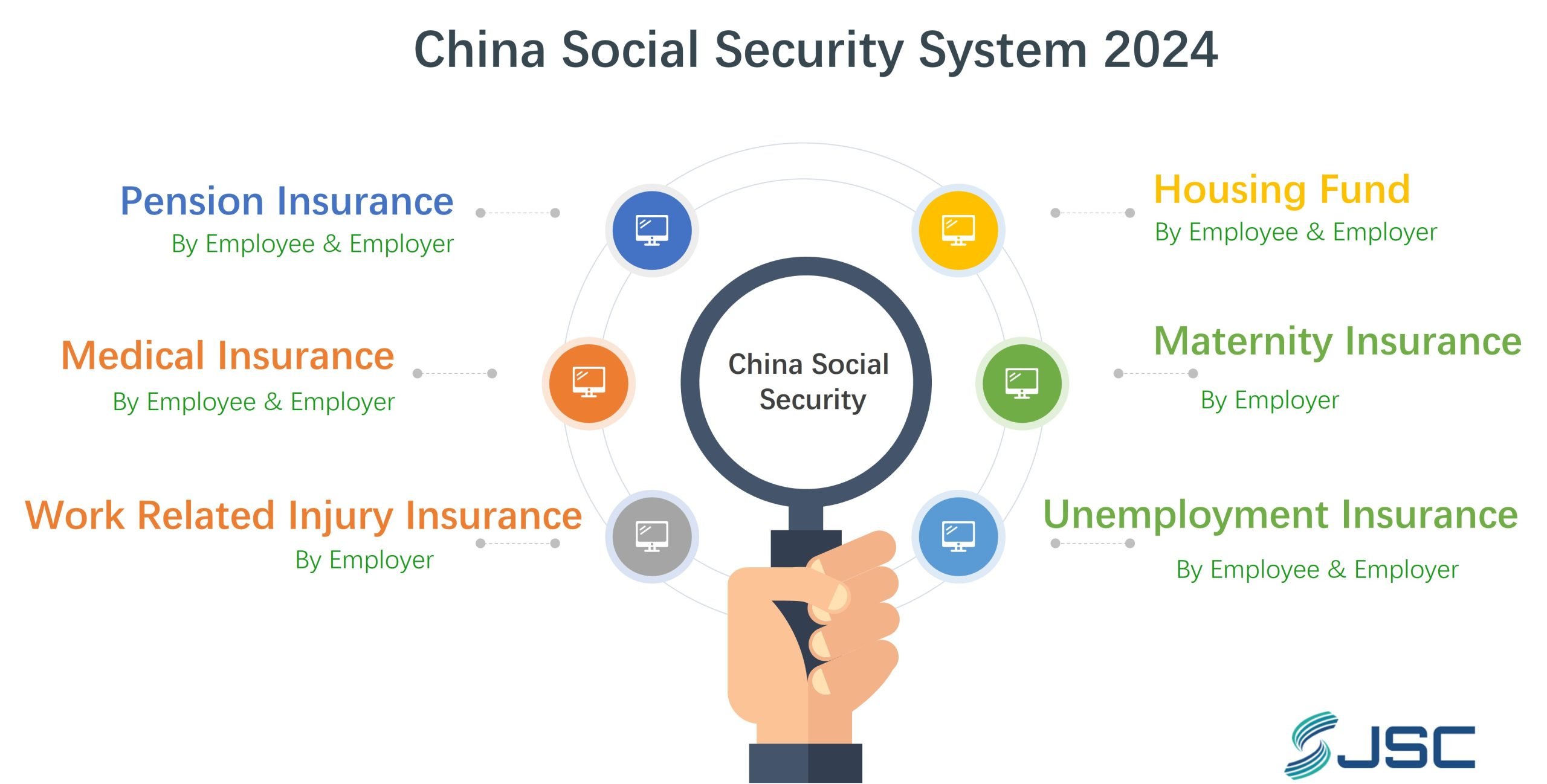
Employee’s contributions shall be withheld from their monthly gross salary and contribute by employers in China.
The initial social security contribution base for an employee’s first month shall align with the monthly gross salary specified in the employment contract. Subsequently, this contribution base undergoes yearly adjustments, determined by the employee’s average salary from the previous year. Each city annually announces and updates the minimum and maximum contribution base limits.
For more details about the China mandatory social security contributions, please read
Complete Guide on China Social Security System
Hiring Cost in China III: Disability Fund/Supplementary Benefits/Insurances
Disability Fund:
Employers should be mindful that the Disability Fund is a mandatory requirement in China, with contribution percentages and bases varying across cities. However, companies that employ a certain number of disabled individuals may qualify for an exemption from the Disability Fund contribution.
In addition to the mandatory social security contributions, employers in China may offer supplementary benefits to attract and retain talents. These benefits can include:
Private Health Insurance:
This provides supplementary health coverage beyond the mandatory health insurance in China, catering to expenses not covered by the compulsory insurance. Costs for private health insurance vary based on factors such as the employee’s age, desired insurance coverage, location, and other individual preferences.
Employer Liability Insurance:
China Employer Liability Insurance safeguards businesses against legal liabilities arising from employee-related claims in China, including workplace injuries, accidents, or illnesses. This coverage typically includes compensation for medical expenses, lost wages, and legal fees. The cost of China Employer Liability Insurance varies based on factors such as the size of the workforce, industry type, and risk assessment.
Hiring Cost in China IV. Trade Union Fees
Trade union costs in China are obligatory for companies with a total employee count exceeding a specified threshold, necessitating the establishment of a union. Under this regulation, all hired employees are required to contribute to the union, with the fee set at 2% of their monthly gross salary. This fee supports the operational expenses and activities of the trade union, ensuring representation of employees’ interests and compliance with labor regulations.
Hiring Cost in China VI – One time payment, severance pay.
The severance payment in China shall be based on the number of years the employee has worked for the employer at the rate of one month salary for each full year worked. Any period of no less than six months but less than one year shall be counted as one year. The severance payment payable to an employee for any period of less than six months shall be one-half of his/her monthly salary.
In addition to severance payments, employers in China are required to compensate employees for any unused annual leave upon termination of employment. Unused annual leave days result in compensation equivalent to 300% of the employee’s daily wage for each day.
Example Hiring Cost in China
Employee Details:
Position: Sales Manager
Working City: Shanghai, China
Monthly Base Salary: 20,000
Supplementary Benefits: N/A
Trade Union: N/A
1. Employee Monthly Gross Salary: 22,000 RMB
Monthly Base Salary: 20,000 RMB
Commission: 1,000 RMB
Bonus: 500 RMB
Overtime Payments: 500 RMB
2. Employer Social Security Contribution – 7021.20 RMB
Contribution Base: 20,000 RMB.
Total Employer Contribution: 7021.20 RMB
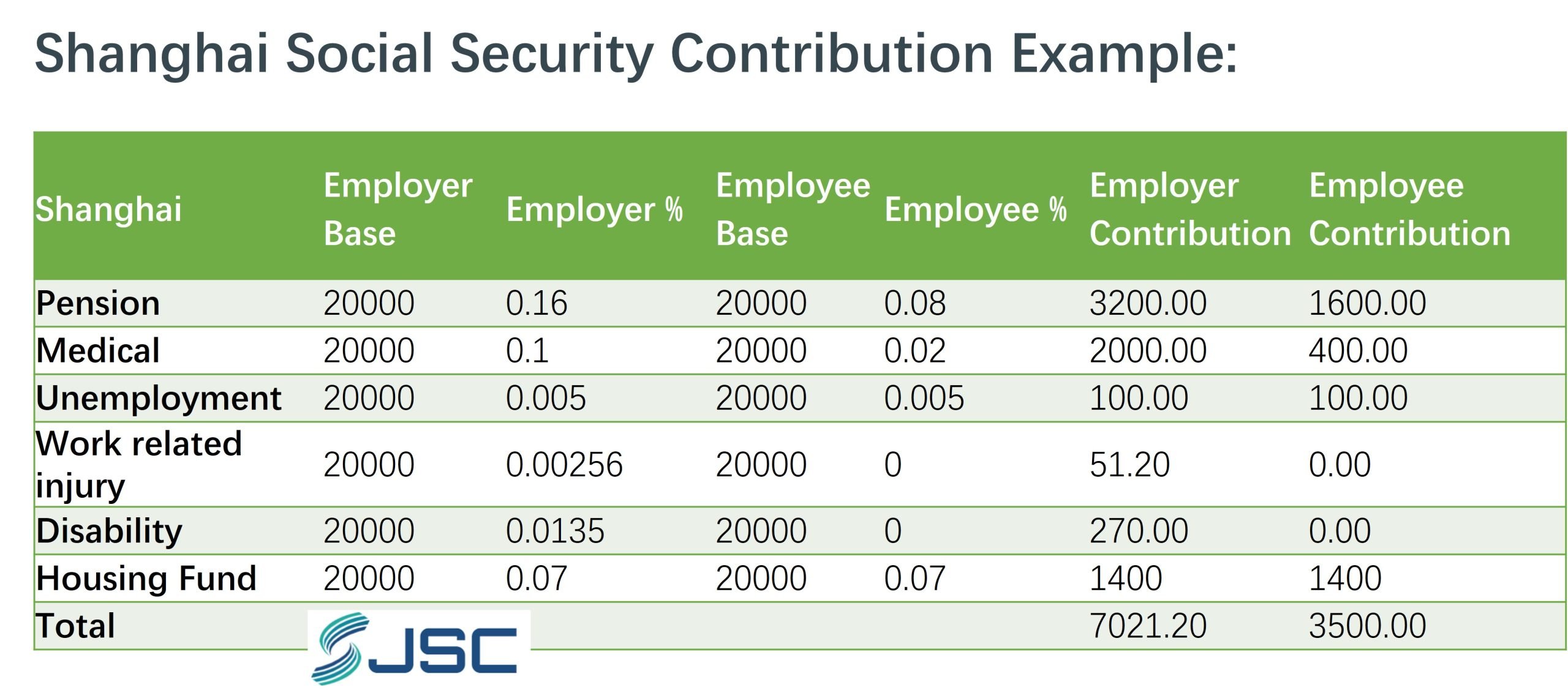
3. Total Monthly Hiring Cost: 29021.2 RMB
In conclusion, employers must be mindful that hiring costs vary across cities in China, primarily due to differences in mandatory social security contribution policies. Understanding local regulations is crucial to ensure hiring compliance. Employers may opt to engage professional HR service providers to navigate these complexities effectively.
Different Options of Hiring in China
For foreign companies who already have the legal entity in China, you are able to hire employees in China directly. In the meanwhile, you can engage a professional China payroll and HR service provider to handle your employees’ monthly payroll, and social securities to ensure the compliance in China.
For companies who have no legal entity in China or in the process of setting up the legal entity in China, you have to engage a China EOR/PEO service provider to legally handle your Chinese employees’ China hiring, China payroll and mandatory social security. For more details, please refer to the article How to Hire Employees In China Without Legal Entity?
About JSC – China PEO & Employment Expert.
JSC is a professional service company that assists foreign-invested companies in doing businesses in China.
Our core services China PEO and employment solution enables foreign investors to hire employees in China without setting up any company which allow them to expand into China market in days, not months. Our in-country local experts are also experienced in assisting businesses to compliantly establish their own legal entity in China.
Please contact us if you require any other information on China PEO.
Info@jscgroups.com
Contact Us.
Office
Anyuan Road, No. 1, Jingan District, Shanghai, China.
Guanghua Road, No. 15, Chaoyang District, Beijing, China