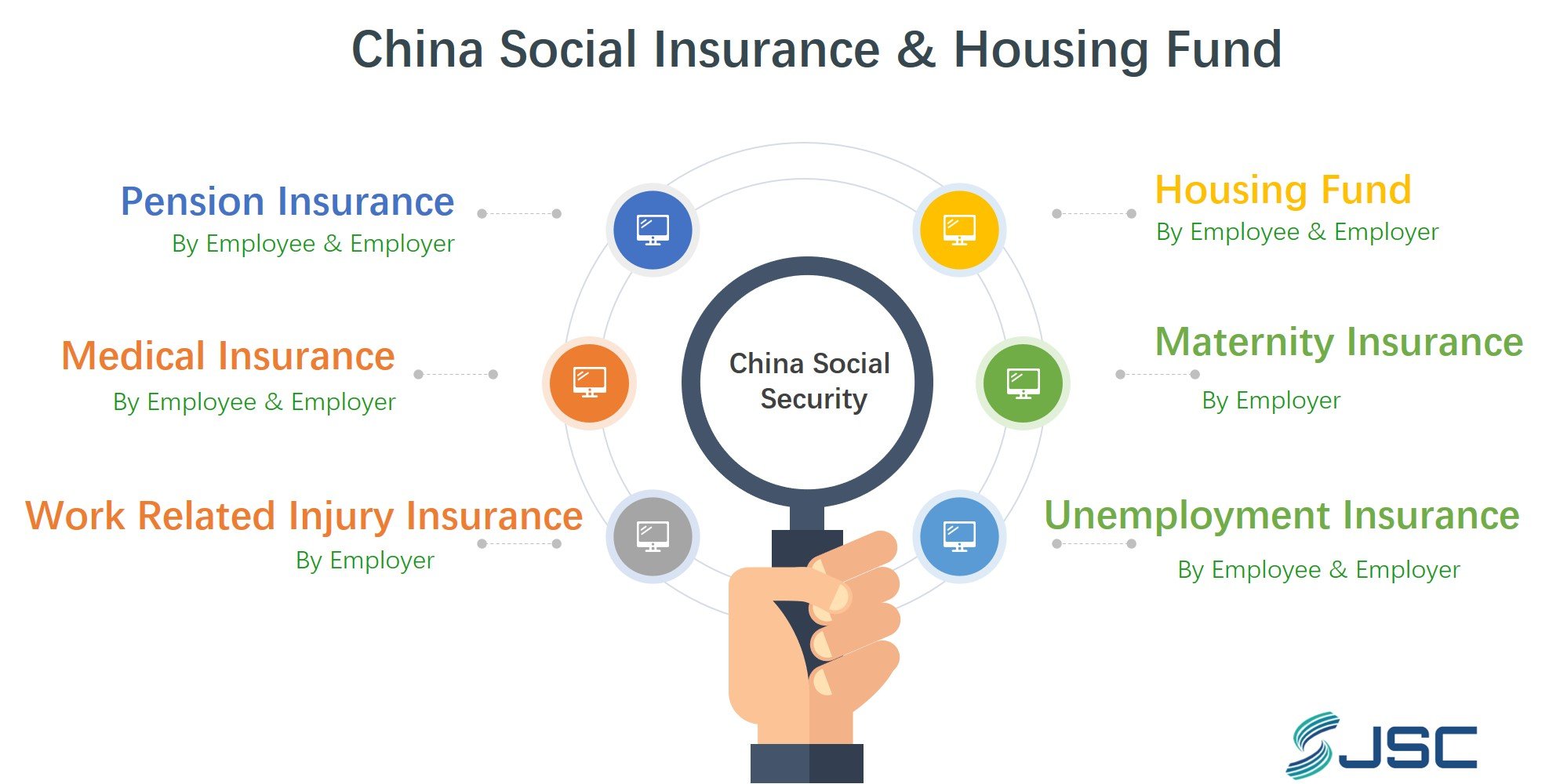
China social security is one of the very important factors when hiring employees in China and one big portion of the China employer payroll taxes. It consists of five different types of insurance, plus one mandatory housing fund. The five “insurances” are pension, medical, unemployment, work-related injury, and maternity insurances.
Introduction of Social Security in China.
According to the China Social Insurance Law and China social security provisions, we have concluded the Basic principles of China social security system which is one part of the China employer payroll taxes you shall know when hiring in China:
- All employees including foreigners working in China shall be covered by China social security system.
- Both employers and employees are required to make the China social security contributions as the China employer payroll taxes
- China social security contributions are made on the monthly basis and adjusted on the yearly basis.
- Each city in China has its own social security contribution base and rate.
- All the China social security funds are managed by each city’s local authority and are pooled into provincial or municipal funds.
- Employers’ mandatory China social security contribution obligations which is the China employer payroll taxes cannot be exempted by mutual alignment between employers and employees.
- If client has no legal entity in China, they shall engage China EOR and China PEO & employment agency to handle China social security for their employees in China.
- All foreigners working in China shall contribute China social security.
- Company shall set up the company social insurance account after company establish in China.
Components of China Social Security System
Pension Fund in China
Employees in China who have contributed to pension insurance for more than 15 years can receive a monthly pension when they reach the statutory retirement age under China social security system.
Employers and employees are both required to contribute to the China pension system. Contributions from employees will be credited to their personal pension account. The employer’s contribution will be deposited in the government’s public account.
The retirement age in China varies according to gender and position. In general, males must retire at the age of 55, while females must retire at the age of 50. However, due to China’s aging population, the government intends to raise the retirement age.
Pension each employee can get monthly is coming from two portion.
- Employees’ personal pension accounts: accumulated through employee contributions and divided into 120 installments to be paid out monthly over a ten-year period.
- Government public account: All employer contributions are directed to the government public account in China, which is managed by the China central government. These funds are used to pay employees’ pensions based on their working years and average salary. Employee can receive it till death.
China Medical Insurance
Medical insurance in China is also paid on a monthly basis under China social security system by both the employee and the employer. The employee’s contribution goes directly to their personal medical account, while 30% of the employer’s contribution goes to the employee’s personal medical account and the remaining 70% goes to the government public account.
Employees can use their medical account funds to pay for medical treatments in hospitals in part or in full, depending on the medications and treatments they receive.
Medical insurance in China only covers treatment accepted and managed by government-approved hospitals; international hospitals, private hospitals, private rooms, and imported medicines are not covered.
China Unemployment Insurance
Unemployment insurance in China is one part of the China social security must be paid for by both the employer and the employee regulated in China social security system.
The contribution is fully deposited into the government’s public account and is used to provide a minimum level of support as a benefit to individuals who meet certain criteria and are unemployed in China.
Employees in China can use the government App to apply for benefits on their own. The length of the benefits is determined by how long the employee has contributed to the social security system; the maximum benefits available are 24 months.
In Shanghai, for example, unemployment benefits are RMB 2,255 per month for 1-12 months of unemployment, and RMB 1,804 per month for 13-24 months of unemployment in 2024.
China Work-Related Injury Insurance
Work-related injury insurance are paid solely by employer in China. The contribution rate are different from company to company, depends on the work safety, risks of different industries in China, usually range from 0.5%-2%.
The entire contribution was deposited into the government’s general fund. When your employees in China suffer a work-related injury or illness, the work-related injury fund pays for their treatment.
Employees are eligible for work-related injury compensation if they can demonstrate that they have a working relationship with their employer and that the injury sustained was caused by their job. Employers must file the application, which must be approved by each local social security authority in China.
China Maternity Insurance
Maternity insurance is contributed by employer only for each employee they hire no matter male or female on the monthly basis. The contribution is paid into the government’s public account and is used to compensate female employees during their maternity leave periods.
Women who have been working and contributing to social security for more than three months are eligible for such compensation in China. Different cities have different policies and implementation methods.
In Shanghai, for example, the monthly compensation women can receive from the government is equal to their company’s average salary from the previous year. Generally, employers are not required to pay employees’ salaries during their maternity leave; however, if an employee’s salary is higher than the company’s average salary, the company is responsible for paying the difference. In Shanghai employee can apply for such compensation by themselves while in Beijing it shall be applied by employer.
China Housing Fund
Both employers and employees must make monthly contributions to the housing fund, and all housing fund contributions go directly to employees’ housing fund accounts in China; such funds can be used for housing mortgages when an employee buys a house.
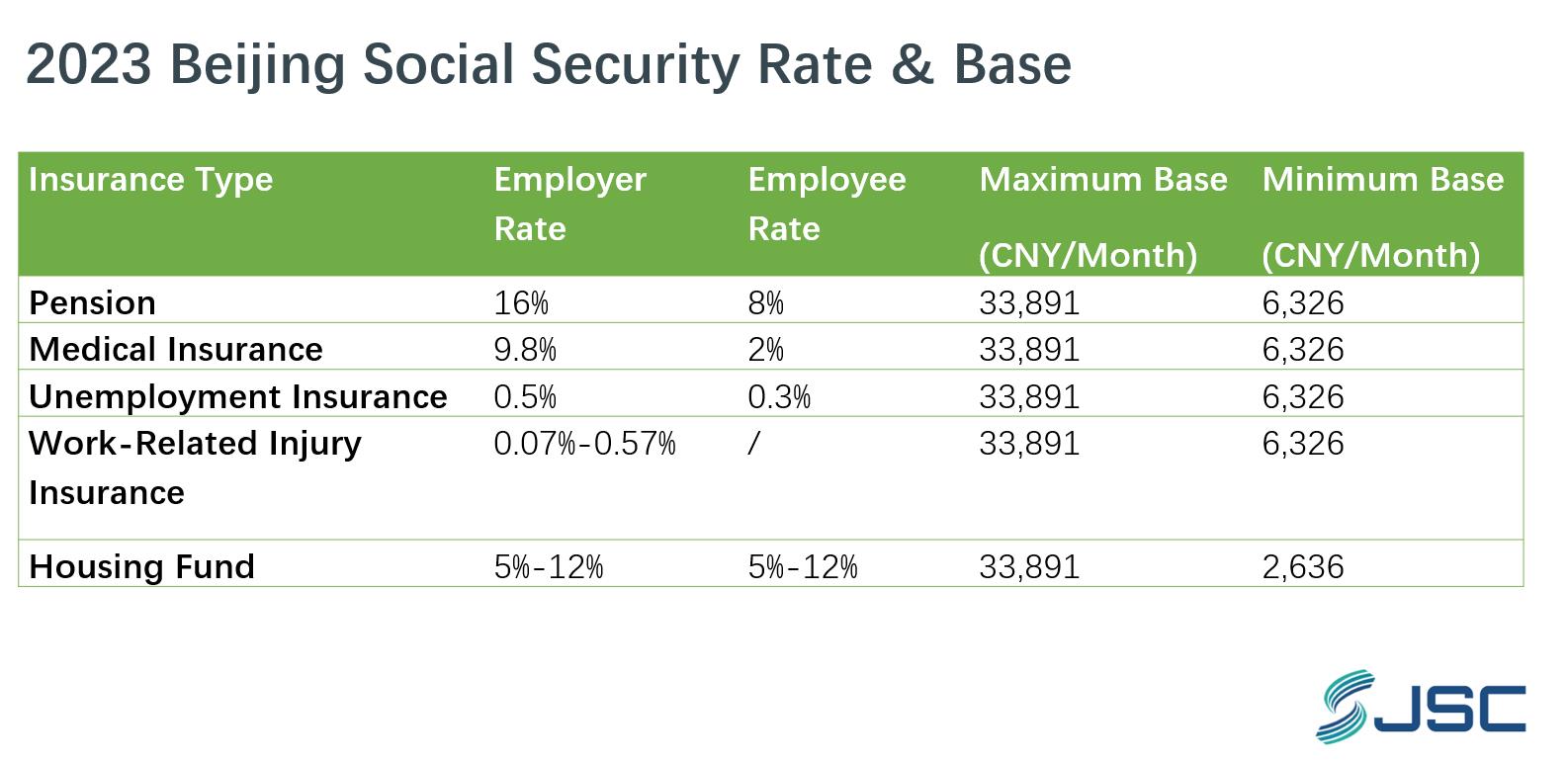
The actual percentage of contribution varies by city or province. In Shanghai, the employer and employee contribution percentages are the same, at 7%. In some cities, the housing fund contribution rate is a range; for example, in Beijing, the range is 5% to 12%. Employers can choose a percentage for the housing fund contribution; however, each company can only have one contribution percentage for all employees, and employees’ contribution percentages must be the same as the employer’s in China.
Additional Insurances/Benefits Employer can Offer in China.
Supplementary China Housing Fund
Employers may choose to contribute an additional percentage of supplementary housing funds to their employees in China as an added benefit, as this is not required in China. The contribution percentage must range between 1% and 9%. Both the employer and the employee must contribute the same percentage, and the entire contribution fund is directed to the employees’ housing fund account. When an employer decides to provide supplemental housing funds to their employees, all employees must enroll.
Supplementary Health Insurance/Commercial Insurance in China
It is very common for foreign companies to provide commercial insurance to their employees in China as supplemental health insurance and mentioned in the labor contract. This is not under the Chins social security system. Typically, commercial insurance is provided by an insurance agency. Employers can select from a variety of plans based on their budget and employee position or level. Some plans, for example, may cover private hospitals, and imported medicines are typically provided to expats or senior management staff. After enrolling in a commercial insurance plan, employees can submit hospital receipts and doctor’s statements to the insurance agency to claim their hospital expenses.
Supplementary health insurance is quite common among foreign companies when hiring in China.
China Employer Payroll Taxes – Social Insurance and Housing Fund Contribution Base and Rate.
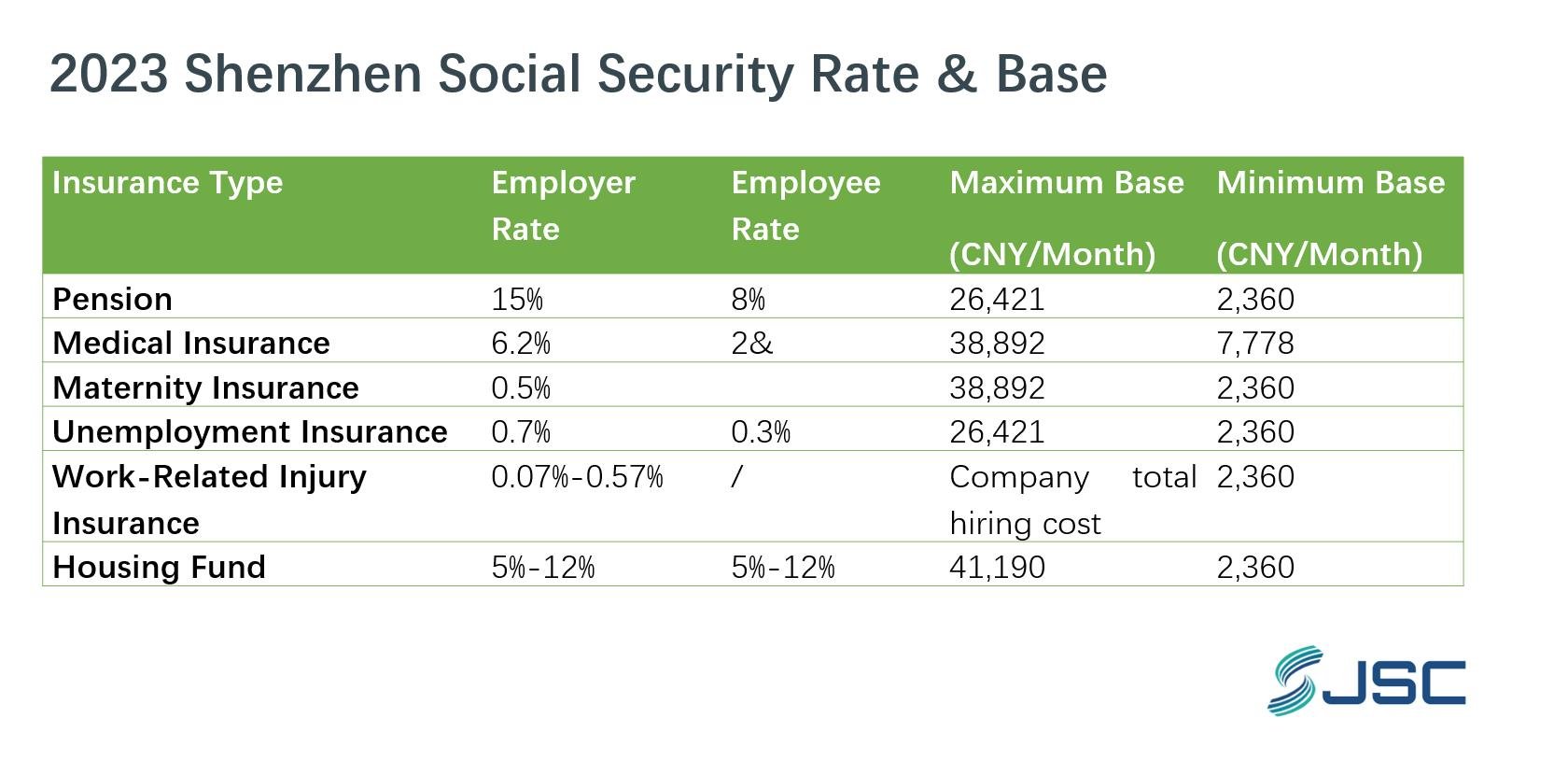
Different cities have different contribution rates and bases for social insurance and housing funds, and such policies will be updated yearly by each city. The latest China social security policies in Shanghai, Beijing, and Shenzhen are listed below.
China Employer Payroll Taxes – Social Security Policy – Shanghai:
Period: 2023.7-2024.6
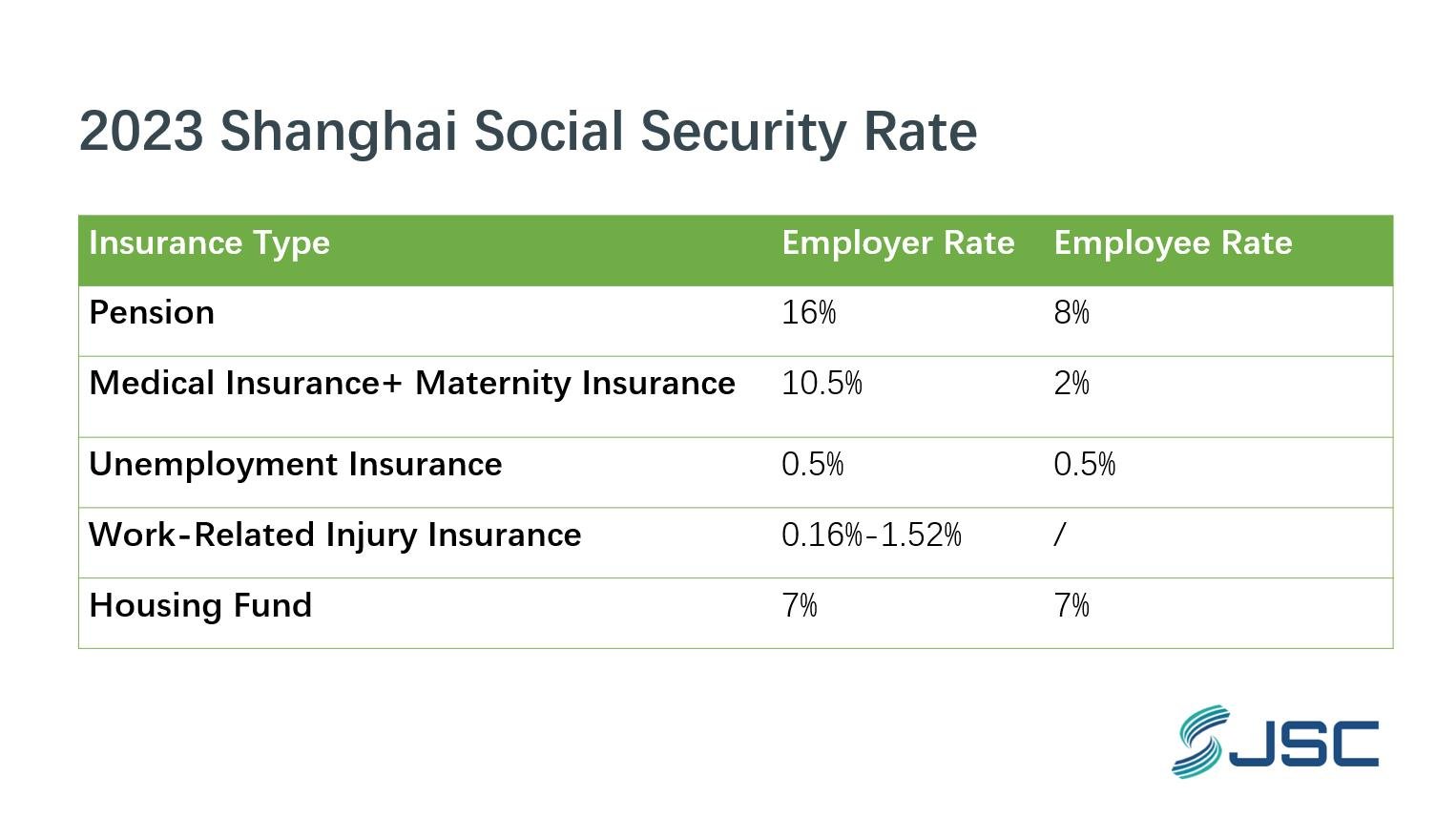
Contribution Base:
Maximum: RMB 36,549
Minimum: RMB 7,310
China Employer Payroll Taxes – China Social Security Policy – Beijing
Period: 2023.7-2024.6
China Employer Payroll Taxes – China Social Security Policy – Shenzhen
Employee Type: Shenzhen Hukou
Period: 2023.7-2024.6
China Social Security Exemptions for Foreigners
According to the Interim Measures for Participation in the Social Insurance System by Foreigners Working within China, released on 2011, all foreigners working in China are required to contribute China employer payroll taxes, social security in China. Housing fund is not mandatory for foreigners.
Foreign employees from countries that have signed social security exemption treaties with China, on the other hand, are eligible for social security exemptions which can help the company to save the China employer payroll taxes. To be eligible for such exemptions, foreign employees must submit the necessary documentation from their employer in China. For your convenience, here is a list of countries:
Germany, South Korea, Denmark, Canada, Finland, Switzerland, and the Netherlands, Spain, Luxembourg, Japan, and Serbia
Foreign companies doing business in China must contribute to China employer payroll taxes and China social security on time and in full. Each year, the local social security authority will select companies at random to conduct the social security audit. Any delay in making the contribution, or making the contribution on the incorrect basis, will all have an impact on the company’s credit with the government.
About JSC – China EOR, China PEO & Employment Expert.
JSC is a professional service company that assists foreign-invested companies in doing businesses in China.
Our core services China PEO and employment solution enables foreign investors to hire employees in China without setting up any company which allow them to expand into China market in days, not months. Our in-country local experts are also experienced in assisting businesses to compliantly establish their own legal entity in China.
Please contact us if you require any other information on China PEO.
Info@jscgroups.com
Frequently asked questions for payroll and hiring employees in China.
No, you do not need.
If you don’t have a company in China, you can hire employees through PEO service through the employment agency in China.
a) Hire employee through the PEO/employment service.
If you don’t have a legal entity in China, this is the only compliance way to have employee working for you in China.
b) Hire employee under WFOE.
If you already set up a WFOE in China, you can sign the labor contract with employees directly. You can either choose to handle their payroll land benefits yourself, or you can choose to outsource.
c) Hire employee under representative office (Ro)
Representative office in China is not allowed to hire employees directly. The only compliance way is hire employees through labor dispatch agency under PEO service
PEO refers to a professional employment organization, in China it’s also called employee outsourcing, labor dispatch. Foreign companies can hire staff in China through a PEO agency without setting up a legal entity in China.
Severance payment in China is based on the number of years employee has worked for the company.
Each full year employee worked for your company, one month salary shall be paid as severance payment.
For the working periods that are less than 6 months, half month salary shall be paid.
If employee’s monthly salary is higher than 3 times local average monthly salary, each year of the severance payment compensated shall be 3 times local average monthly salary.
If employees are in the probationary period, both employee and employer shall give 3 days as notice period for termination.
After probationary period, both employee and employer shall give 3o days as notice period for termination.
If employer need immediate termination, employer shall compensate one month salary.
No, you do not need.
No, You shall have a company registered in China to sign a written labor contract with each of your employee.
In practice, employer will sign a fixed term contract with their employee. However, when it goes to the third time renewal of the contract, then the contract becomes to a permanent contact.
Sign a two years or three years contract is more common in China.
Labor contract in China shall be at least in Chinese, and including but not limited to:
Company details including full name, address and legal representative or person in charge.
Employee details including full name, ID number, address.
Term of the employment contract; (E.g., 2 years, 3 years…).
Position (job title), location(city), working hours, holidays, leaves.
Package: gross salary, bonus, commission, social insurance, other benefits.
Occupational safety, and occupational hazard prevention.
Other terms which laws and regulations required.
You need to set up a company in China and then set up a separate Social Insurance and Housing Fund Account. After the company has been set up, you can contribute the benefits to the employees who have signed a contract with you.
The most popular job portals in China is: Zhaopin.com, Liepin.com, zhipin.com. However, these three job portals only accept a registered company in China.
If you don’t have a company in China, you can search candidates through Linkedin.com or engage a headhunting or recruitment firm to help you search the candidates.
In China, employees’ individual income tax (personal tax) shall be declared monthly by the employer, and yearly by employee themselves.