Hiring employees in China can be complex and costly—especially for foreign companies without a local legal entity. A China Employer of Record (China EOR) offers a compliant and cost-effective alternative, but one of the most common questions employers ask is:
How much does a China Employer of Record cost?
This guide breaks down China EOR pricing structures, key cost components, and how China EOR compares to setting up a legal entity in China, helping you determine whether China EOR is the right solution for your 2026 business expansion or hiring strategy in China.
Contents
- What Is Included in China EOR Costs?
- Example: China EOR Monthly Hiring Cost
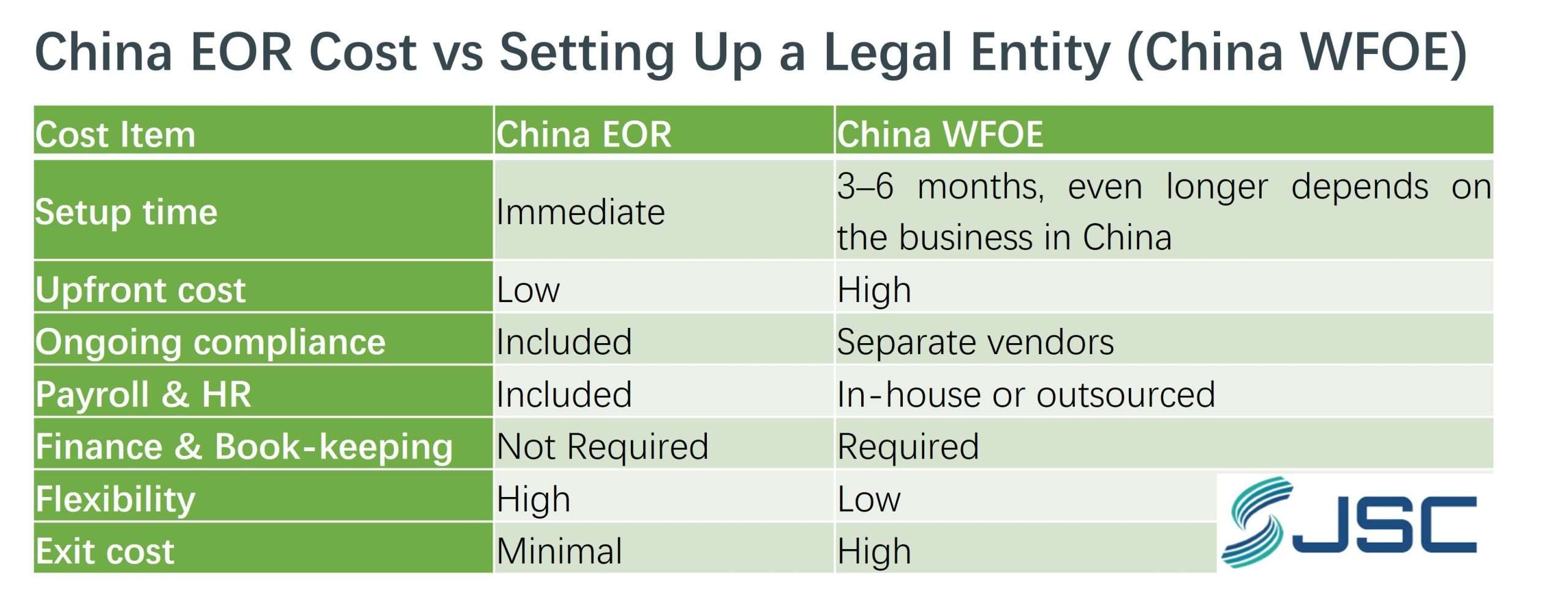
- China EOR Cost vs Setting Up a Legal Entity (China WFOE)
✅ What Is Included in China EOR Costs?
China EOR hiring costs consist of the following elements:
- Employee’s Monthly Gross Salary
- Employer’s Statutory Social Insurance Contributions in China
- Trade Union Fee
- Employer Liability Insurance
- China EOR Service Fee
- Value Added Tax (China VAT)
1. Employee’s Monthly Gross Salary
Employee’s monthly gross salary in China is the amount agreed between the employee and the employer and stated in the China employment contract signed with the China Employer of Record (China EOR).
Company should note that the China monthly gross salary is not the employee’s take-home pay. The China EOR agency will withhold the employee’s portion of China social security contributions and individual income tax in accordance with Chinese regulations, and the employee will receive a net salary after these statutory deductions.
2. Employer’s Statutory Social Insurance Contributions in China
Under China labor law, employers must contribute to mandatory social insurance schemes for all full-time employees in China on the monthly basis, which typically include:
- Pension
- Medical insurance
- Unemployment insurance
- Work-related injury insurance
- Maternity insurance
- Disability fund
- Housing fund
Contribution rates and calculation bases vary by city in China, making location a key factor in overall EOR cost. For more details regarding China mandatory social security contributions, please read the article here.
3. Trade Union Fee
China Trade union fees apply when a company’s total employee headcount exceeds the statutory threshold. For established and reputable China Employer of Record (China EOR) agencies, the total number of EOR-employed staff in China typically exceeds this threshold, which requires the China EOR to establish or participate in a trade union.
As a result, all employees hired under the China EOR arrangement are covered by the trade union, and the China EOR is responsible for paying the applicable union fee in accordance with local regulations. EOR employees are also entitled to the corresponding trade union benefits and protections provided under Chinese law.
4. Employer Liability Insurance
Employer liability insurance is not legally mandatory in China, but it is widely adopted by professional China Employer of Record (China EOR) providers. As the China EOR acts as the legal employer, this insurance helps manage potential employment-related risks and provides additional protection for foreign clients, reducing exposure to unforeseen liabilities.
5. China EOR Service Fee
China EOR service fee covers the administrative and compliance services provided by the China Employer of Record, including:
- New employee onboarding and registration
- Employment contract preparation and management
- Monthly payroll calculation and salary disbursement
- Monthly pay-slip preparation and distribution
- Individual income tax (IIT) calculation and monthly filing
- Social insurance and housing fund administration
- Ongoing HR support and labor law compliance management
- Employee offboarding and exit procedures
China Employer of Record Service Fee Models
China EOR providers generally use one of the following service fee models:
- Fixed Monthly Service Fee per Employee
This is the most common model.
Charged per employee, per month
Covers standard EOR services in China
Predictable and easy to budget
Typical range:
👉 USD 300 – 800 per employee per month
(depending on city, headcount, and service scope)
2. Percentage of Gross Salary
This service fee model is not commonly used in China EOR services, but some China EOR providers may apply it for special or complex hiring scenarios, such as senior management roles, foreign employee hiring, or freelancer engagements.
The service fee is calculated as a percentage of the employee’s monthly gross salary
The percentage varies depending on role complexity and compliance requirements. Often ranges between 5% – 15%
This model may result in higher overall costs, particularly for senior or high-salary positions.
3. Customized or Tiered Pricing
Used for:
- Larger teams
- Multi-city hiring
- Roles requiring enhanced HR or compliance support
Pricing is tailored based on complexity and scale.
Hidden Costs to Watch Out For
When comparing China EOR providers, be aware of:
Setup or onboarding service fees
Contract amendment service fees
Termination handling costs/offboarding service fees
City-specific compliance surcharges
A transparent China EOR provider should clearly outline what is included and what is not from the beginning.
6. China Local Tax: Value-Added Tax (China VAT)
Value-Added Tax (VAT) treatment for China EOR services depends on the client’s legal presence in China.
If the client does not have a legal entity in China, VAT is generally applied to the total EOR invoice amount, including employment costs and the EOR service fee.
If the client has a registered legal entity in China, such as a China WFOE or China Representative Office, VAT is typically applied only to the EOR service fee, in accordance with applicable tax regulations.
The effective VAT rate applied to China EOR services is usually around 6.78%, subject to local tax treatment and invoicing arrangements.
✅ Example: China EOR Monthly Hiring Cost
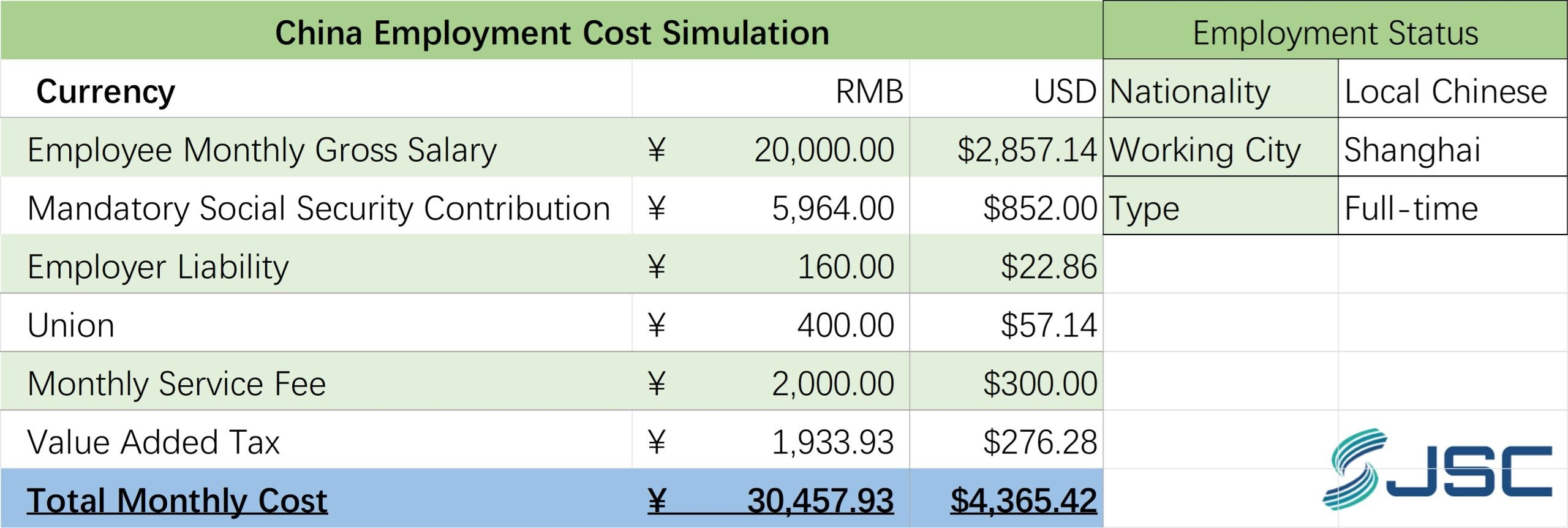
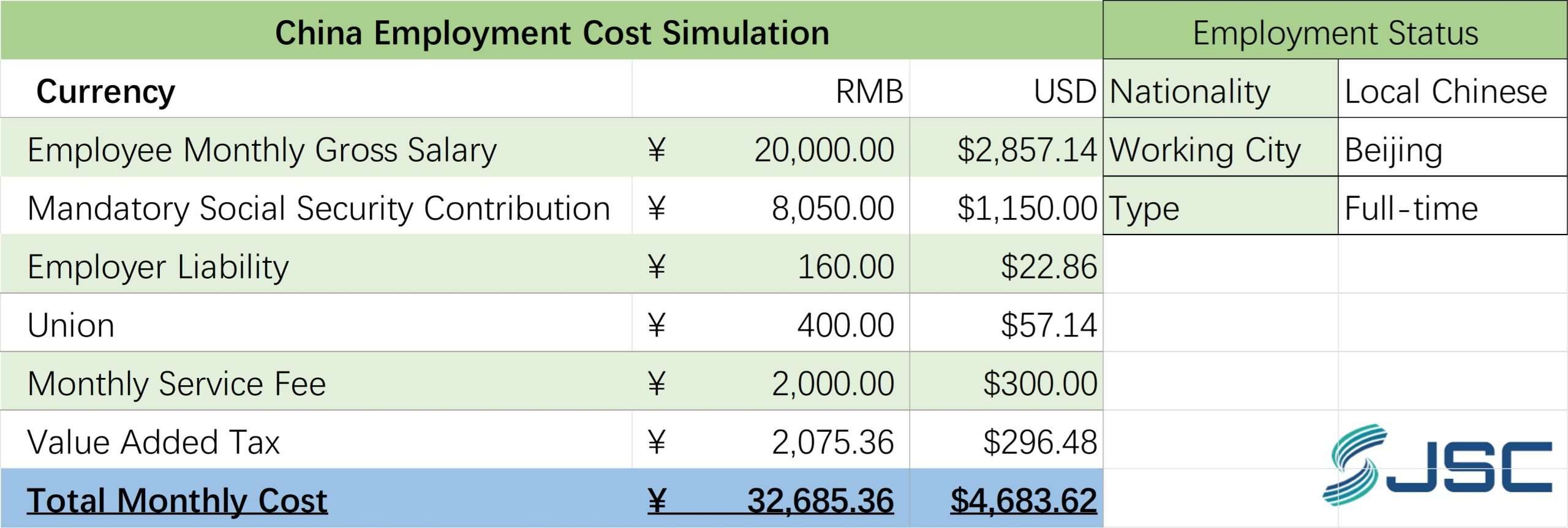
Let’s assume you hire two employees, one based in Shanghai and the other in Beijing, each with a gross salary of RMB 20,000 per month, and the client does not have a legal entity in China. The estimated monthly cost under a typical China EOR arrangement would be as follows: